Ecommerce has become increasingly visual, but creating enough product videos to support a large catalogue is still difficult. A brand may manage hundreds of products, multiple collections, seasonal launches, paid campaigns, product pages, and several audience segments. The production demand adds up quickly.
Traditional video production often means coordinating scripts, shoots, editors, voiceovers, approvals, and several rounds of revisions. AI product video creation for ecommerce changes the starting point by turning approved product information and existing creative assets into material for scripts, scenes, voiceovers, and variations, without rebuilding the process from scratch each time.
The important shift is not simply that AI can generate clips on demand. Product video is becoming a repeatable part of the ecommerce content workflow, built from product pages, photography, brand guidance, and existing footage. People remain responsible for accuracy, brand fit, and the final creative decision.
Product Information Is Becoming Video Material
Most ecommerce brands already have the raw ingredients for a useful product video.

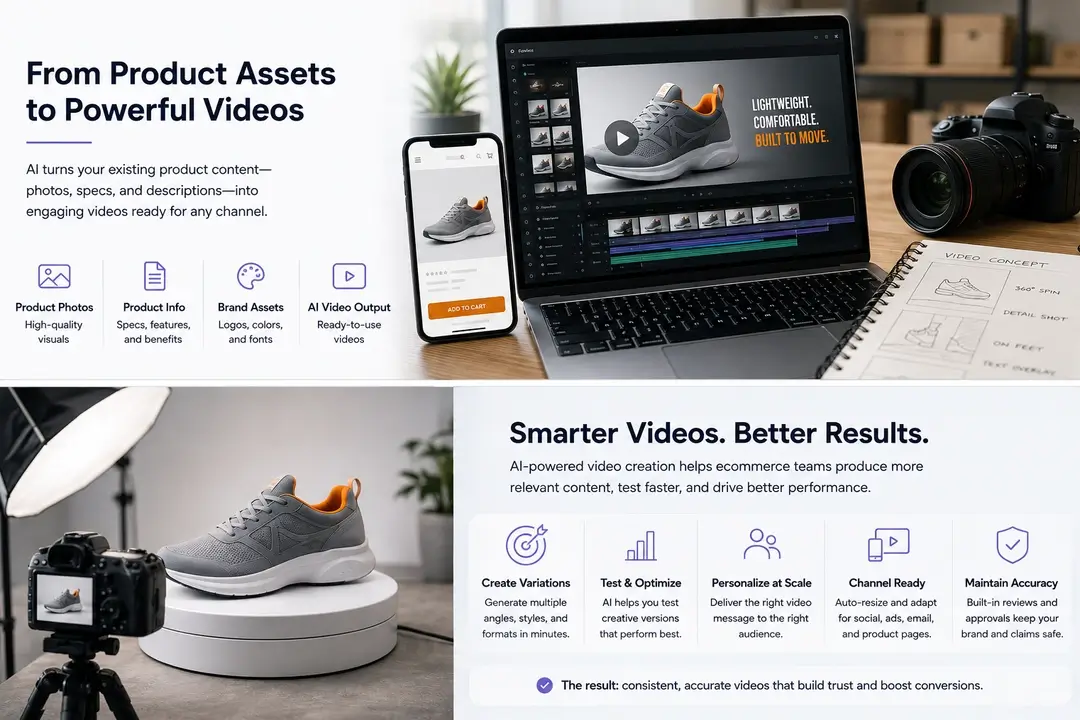
Product descriptions explain features and benefits. Photography shows appearance, materials, packaging, and colour. Reviews and support questions reveal what shoppers want clarified. Brand guidelines establish tone and visual identity.
AI can connect those pieces and turn them into different video concepts. A product description can become a demonstration script. Approved photos can guide the visual treatment. Common customer questions can shape the opening hook or decide which feature deserves more screen time.
Instead of treating every product as a new production assignment, marketing teams can begin with information the business has already reviewed and build from there.
Invideo Agent Turns Product Details Into Creative Assets
Invideo agent takes a project-based approach to this work. Instead of asking a marketer to turn every product detail into a separate script, storyboard, voiceover, and edit, the same project context can carry source material through multiple stages of production.
As of August 2026, Invideo says its platform provides access to 200+ AI models for video, image, audio, and music. Teams can use the workspace for scripting, storyboarding, visual generation, voiceovers, music, and editing, with the system routing work across models based on the project.
Agent Two also supports multi-input project context, including videos, scripts, PDFs, links, and rough cuts. Ecommerce teams can create specialist agents for roles such as creative director, scriptwriter, storyboard artist, or cinematographer. That makes it easier to explore campaign concepts, including AI UGC Ads, around the same product without re-briefing every step.
One Product Can Support Multiple Video Concepts
One of the most useful changes AI brings to ecommerce is the ability to think beyond a single product video.
A product might need a short social ad, a demonstration, a product-page video, a customer-style creative, an email cutdown, and a retargeting version. The facts may stay the same, but each video’s job is different.
Previously, creating all of those versions could mean repeating much of the production process. AI makes it easier to start with the same approved product information and develop different cuts for different placements, audiences, and stages of the buying journey.
Different Messages for Different Shoppers
A new visitor may need a simple introduction. Someone comparing alternatives may want a feature demonstration or a clearer sense of scale. A returning customer may be more interested in a new use case or complementary product.
AI makes it easier to adapt the same product story without starting from scratch. The same kitchen appliance could have a 15-second overview for discovery, a feature-led comparison cut for consideration, and a setup tip for existing owners.
Product Images Can Become Video Inputs
Ecommerce brands already invest heavily in product photography. AI gives those existing images another role in the content workflow.
Instead of keeping product photos limited to product pages and static ads, marketers can use them as references for motion-based content. A still image can become the starting point for an animated scene, product reveal, close-up sequence, or short promotional cut.
Getting More From Existing Assets
This can be especially useful for products that are difficult or expensive to film repeatedly. Brands can explore new visual treatments while continuing to use approved product photography as the reference point.
Older creative can also have a longer useful life. Images from earlier launches, seasonal campaigns, or catalogue shoots can become starting points for new concepts.
Creative Testing Becomes Easier
AI also makes experimentation more practical.
An ecommerce team can create several drafts with different hooks, benefit order, pacing, or visual approaches before deciding which ideas are worth polishing.
From One Ad to a Set of Variations
A single product can be presented through different creative angles. One version might focus on the problem it solves, another on a specific feature, and another on how the product fits into everyday use.
That turns video into an ongoing testing tool rather than a one-time campaign asset. Each version should still have a clear purpose: a specific shopper question to answer, a benefit to prove, or a message to test.
Personalization Is Moving Closer to the Workflow
Useful personalization does not require a completely different campaign for every shopper.
A first-time buyer may need orientation. Someone comparing alternatives may want proof or detail. An existing customer may respond better to a new use case or accessory. AI reduces some of the production overhead involved in adapting the opening, emphasis, or format for those needs.
More Relevant Product Stories
Ecommerce brands can experiment with videos that change the opening message, product benefit, tone, or presentation according to the audience or placement.
What an AI Product Video Workflow Looks Like in Practice
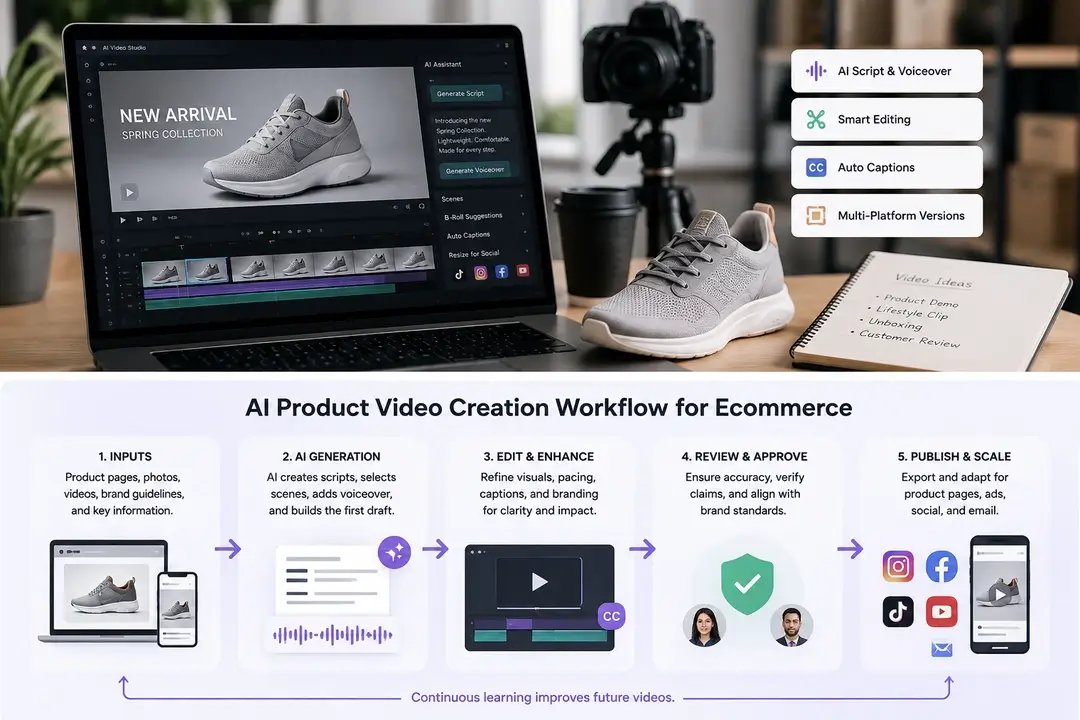
A useful AI video workflow starts before anyone writes a prompt. It begins with a clear customer question and approved source material.
- Define the job. Decide whether the video should introduce the product, demonstrate a feature, answer an objection, compare options, or support retargeting.
- Gather approved inputs: the current product page, specification sheet, product photography, brand guidelines, existing footage, and useful customer questions.
- Build one strong first draft. Get the story, product claim, visual direction, and call to action right before creating more versions.
- Review for product truth and brand fit, including wording, packaging, colour, proportions, on-screen text, voiceover, and generated product interactions.
- Adapt for the channel. Create the versions needed for product pages, paid social, organic social, or email, then use performance to inform the next round.
This sequence keeps AI focused on production and iteration around a clear brief, without letting speed become an excuse for weak or inaccurate creative.
Video Production Is Moving Closer to Marketing Teams
Traditional ecommerce video production often sits between marketing and creative teams. A brief is created, passed to production, revised, edited, reviewed, and eventually published.
AI is bringing parts of that workflow closer to marketers. A content team can reach a first script, rough visual direction, or set of test concepts before every detail enters a separate production queue.
Creative Teams Can Focus on Direction
That shift does not remove the need for creative professionals. It lets editors, designers, producers, and brand leads spend more time on storytelling, pacing, product presentation, continuity, and the ideas that deserve further investment.
More Video Does Not Automatically Mean Better Video
There is an important limitation to keep in mind: producing more videos does not guarantee better ecommerce marketing.
A product video still needs a clear purpose: answer a question, demonstrate a benefit, reduce uncertainty, or show something hard to understand from a static image.
AI can make production easier, but the creative strategy still determines what deserves to be produced.
Human Direction Still Matters
The strongest ecommerce teams are likely to use AI for experimentation while keeping human oversight around messaging, brand identity, product accuracy, and storytelling. Marketers still have to decide what the customer should see and why.
What Should Be Checked Before Publishing?
- Product claims match the current product page, specification sheet, and approved marketing language.
- The product looks correct, including packaging, labels, colours, materials, proportions, and any visible features.
- Voiceover, captions, on-screen copy, and calls to action match the brand and the offer being promoted.
- The team has the right to use the source assets, music, voices, likenesses, and other material included in the final cut.
- The format, disclosures, and creative treatment meet the requirements of the intended channel and market.
What Ecommerce Video Could Look Like Next
The bigger change may be the move from occasional product videos to ongoing video systems.
Instead of producing videos only for major campaigns, brands can build repeatable workflows that turn product launches, catalogue updates, seasonal promotions, customer questions, campaign learnings, and existing assets into new concepts.
Video then becomes part of the ecommerce content pipeline rather than a separate production event. A new SKU, revised benefit, or fresh audience insight can feed the next creative cycle without rebuilding the process.
Related Posts




Frequently Asked Questions About AI Product Video Creation
What is AI product video creation for ecommerce?
AI product video creation for ecommerce uses AI-assisted tools to turn product information and creative assets into scripts, scenes, voiceovers, edits, and variations. Inputs can include product pages, photos, brand guidelines, footage, and campaign briefs. Human review remains important for accuracy and final creative decisions.
Can AI create product videos from product photos?
Yes. Many AI video workflows can use product photos as visual references or starting frames for motion. That gives existing photography more value. Generated scenes should still be checked for changes to labels, materials, shape, colour, packaging, and other product details.
What types of ecommerce videos can AI help create?
AI can support short ads, product demonstrations, product-page videos, customer-style creatives, launch videos, retargeting cuts, and channel-specific versions. The best format depends on the shopper question and placement; a product-page demo and a paid-social ad usually need different pacing and detail.
Can AI-generated product videos replace a production team?
Not in every case. AI is well suited to first drafts, routine variations, concept exploration, and asset reuse. Experienced creative teams remain important when a project needs strong direction, original filming, complex product interaction, precise continuity, or high-stakes brand work.
How can brands keep AI product videos accurate?
Start with current, approved source material and review the finished video against it. Check claims, dimensions, colours, labels, packaging, relevant specifications, and any scene showing the product in use. If a meaningful detail changes, revise or remove that shot before publishing.
Is AI product video creation useful for large ecommerce catalogues?
Yes, especially when many products need similar content formats. A repeatable workflow lets teams reuse approved structure, brand rules, and production steps across products. Review becomes more important as output increases because small errors can scale too.
Should the same product video be used on every channel?
Usually not. A product page may need explanation and detail, while a social placement may need a faster opening and tighter runtime. Reuse the approved product facts, then adjust pacing, framing, captions, and the call to action for the channel.
Final Thoughts
AI is changing ecommerce product video creation by making the process more adaptable and easier to repeat. Product pages, images, scripts, customer questions, brand guidance, and existing footage can all become inputs for new creative work.
The value is not simply faster production. Ecommerce teams can test more ideas, create useful variations, and adapt product stories for different audiences and channels without treating every cut as a new production.
Invideo agent fits into this shift by combining access to 200+ AI models with persistent project context, specialist agents, scripting, visual development, and editing capabilities. Those tools are most useful when they sit inside a clear process for product accuracy, brand review, and creative judgment.
As ecommerce catalogues continue to grow, brands that build flexible video workflows will have more opportunities to turn product information into content that helps shoppers understand, compare, and choose what to buy.