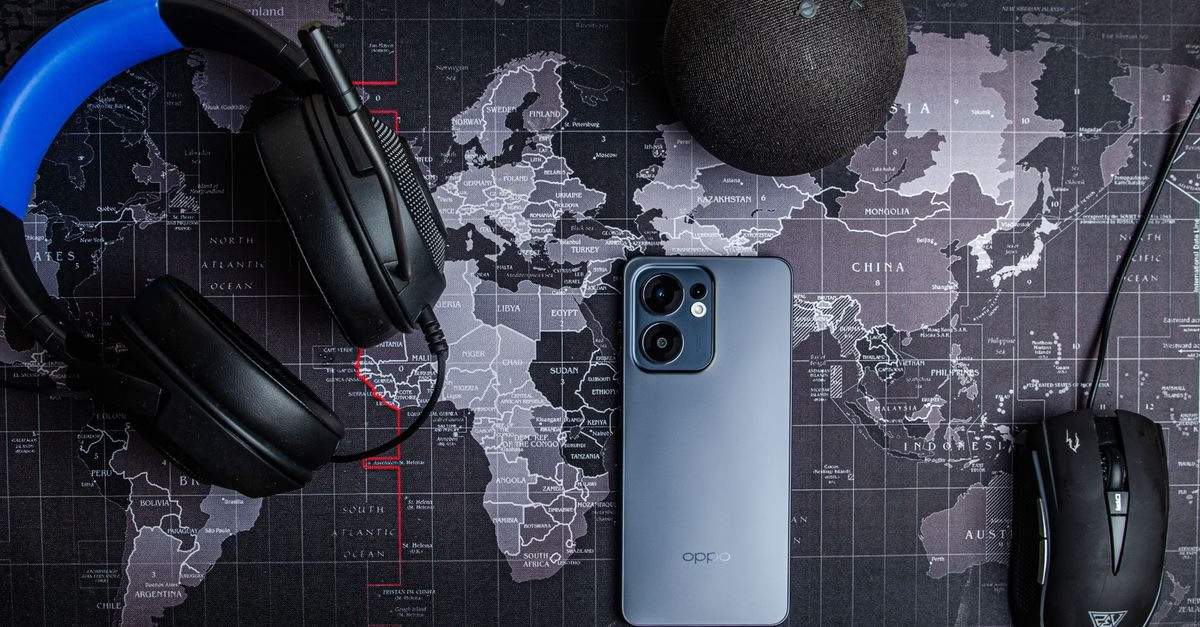
Global rollout begins with Austrian pre-orders
The focus here is Oppo A7 Pro Max. Oppo has officially moved its A7 Pro Max smartphone from its initial Chinese launch in August to broader international markets. The first confirmed European stop for this global debut is Austria, where the device is now open for pre-order. This expansion marks a significant step for the A-series, which typically targets the competitive mid-range segment with balanced specifications.
Consumers in Austria can currently secure the phone in two distinct colourways: Surfing Blue and Lunar Black. The pricing is set at €599, positioning it firmly within the upper-mid-range category rather than the budget tier. Pre-orders are active now, but actual ownership will have to wait slightly longer as the company has scheduled the commencement of shipping for October 1.
Hardware specs drive the user experience
At the heart of the Oppo A7 Pro Max lies the Qualcomm Snapdragon 4 Gen 5 chipset. This processor is paired with 6GB of LPDDR4X RAM and 256GB of UFS 3.1 storage. While the RAM configuration might seem modest compared to some flagships, the UFS 3.1 storage standard ensures faster read and write speeds for app loading and file transfers.
The visual experience is handled by a 6.78-inch AMOLED display. It offers a resolution of 1272×2772 pixels and supports a smooth 120Hz refresh rate. A standout specification here is the peak brightness of 1,800 nits, which should provide excellent visibility even under direct sunlight. This combination suggests a focus on media consumption and everyday fluidity rather than raw gaming power.


Selfie capabilities take center stage
The camera array on the A7 Pro Max reveals Oppo’s strategic priorities for this release. The rear setup includes a 50MP main camera equipped with Optical Image Stabilisation (OIS), which is crucial for reducing blur in low-light conditions and during movement. Accompanying this primary sensor is a 2MP monochrome camera, likely used for depth information or artistic black-and-white shots.
However, the true highlight appears to be the front-facing camera. Oppo has installed a 50MP selfie snapper that features autofocus. This is a relatively rare feature in the mid-range segment, where fixed-focus lenses are more common. Autofocus allows for sharper close-up portraits and better group selfies, indicating that social media content creation is a key use case for this device.
Value proposition for European buyers
Priced at €599, the Oppo A7 Pro Max enters a crowded market in Europe. Buyers will need to weigh the high-resolution display and specialized selfie camera against the competition. The inclusion of OIS on the main rear camera is a practical benefit for everyday photographers who do not want to invest in flagship-level pricing.
The choice of the Snapdragon 4 Gen 5 suggests a balance between performance and efficiency. For users who prioritize battery life and smooth interface navigation over intensive gaming sessions, this chipset should prove adequate. The 256GB storage base model also removes the immediate need for cloud subscriptions or memory cards for most average users.
Missing details and market constraints
While the core specifications are clear, several critical details remain unconfirmed in the current announcement. Battery capacity and charging speeds are not specified in the available data, which are often deciding factors for smartphone buyers. Without knowing if it supports fast charging or how long the battery lasts, it is difficult to fully assess its daily usability.
Additionally, the global rollout is currently limited to Austria in the European context. It is unclear when or if other European countries will receive the device. The reliance on a single monochrome auxiliary camera instead of a versatile ultrawide or telephoto lens may also limit photographic flexibility for enthusiasts who want more creative options beyond the main shooter.
A focused contender for content creators
The Oppo A7 Pro Max represents a targeted approach to the mid-range market. By emphasizing a high-brightness AMOLED screen and a superior autofocus selfie camera, Oppo is clearly appealing to users who value visual quality and social sharing. The €599 price point in Austria sets a clear benchmark for what consumers can expect in terms of build and feature trade-offs.
As shipping begins on October 1, early adopters will be able to verify if the Snapdragon 4 Gen 5 delivers consistent performance in real-world scenarios. For those prioritizing selfie quality and display clarity over raw processing power, this device warrants attention. However, the lack of information on battery life remains a notable gap until further official details emerge.
The inclusion of the Snapdragon 4 Gen 5 chipset warrants a closer look at what this means for long-term device viability. As part of Qualcomm’s entry-level to mid-range portfolio, this processor is engineered primarily for power efficiency rather than peak computational throughput. For the average user, this translates to a device that manages thermal output effectively during extended video streaming or social media browsing sessions. However, users who frequently engage in graphically intensive gaming or heavy multitasking may find the performance ceiling lower than that of devices equipped with higher-tier silicon. The pairing with LPDDR4X RAM, while sufficient for standard Android operations, does not offer the bandwidth advantages of newer LPDDR5 standards, which could impact app switching speeds in heavily loaded scenarios.
Storage configuration is another area where the A7 Pro Max makes a distinct choice by offering 256GB of UFS 3.1 storage as a standard feature. In the current market landscape, many competitors at the €599 price point still offer base models with 128GB of storage, often requiring users to pay a premium for higher capacities. By providing 256GB out of the box, Oppo addresses the growing need for local media storage, particularly for users who capture high-resolution photos and videos without relying on cloud backups. The UFS 3.1 interface ensures that this large capacity does not come at the cost of speed, allowing for quicker installation of large applications and faster file transfers compared to older eMMC or UFS 2.x standards found in budget devices.
The camera system’s reliance on a 2MP monochrome sensor alongside the 50MP main shooter highlights a specific design philosophy focused on depth mapping and contrast enhancement rather than versatile focal lengths. Unlike some rivals that include ultrawide lenses for landscape photography or macro lenses for close-up details, the A7 Pro Max appears to prioritize the quality of the primary image capture. The Optical Image Stabilisation on the main sensor is a critical addition here, compensating for the lack of other specialized lenses by ensuring that the primary photos remain sharp in challenging lighting conditions. This trade-off suggests that Oppo expects most users to rely on the main camera for the majority of their photography, using digital cropping or software-based solutions for wider angles if needed.
From a practical standpoint, the absence of confirmed battery specifications remains a significant variable in the overall value equation. While the Snapdragon 4 Gen 5 is known for its efficiency, the physical size of the battery determines how long that efficiency lasts between charges. Without official data on milliamp-hour capacity or supported charging wattages, potential buyers must weigh the known strengths of the display and camera against this uncertainty. If the device supports only standard charging speeds, the large 6.78-inch AMOLED panel could drain the battery more quickly than anticipated, especially when utilizing the 120Hz refresh rate and high brightness levels outdoors.
Ultimately, the Oppo A7 Pro Max carves out a niche for users who prioritize visual fidelity and selfie performance over raw processing power or camera versatility. The €599 price tag in Austria positions it as a premium mid-range option, competing directly with established players in the European market. Its success will likely depend on how well the real-world battery life matches the efficiency promises of its chipset and whether the autofocus selfie camera delivers tangible benefits for its target demographic. As the global rollout expands beyond Austria, consumers in other regions will be watching closely to see if Oppo maintains this specification balance or adjusts the hardware to meet local competitive pressures.