Single-Key Modules with Independent Processing
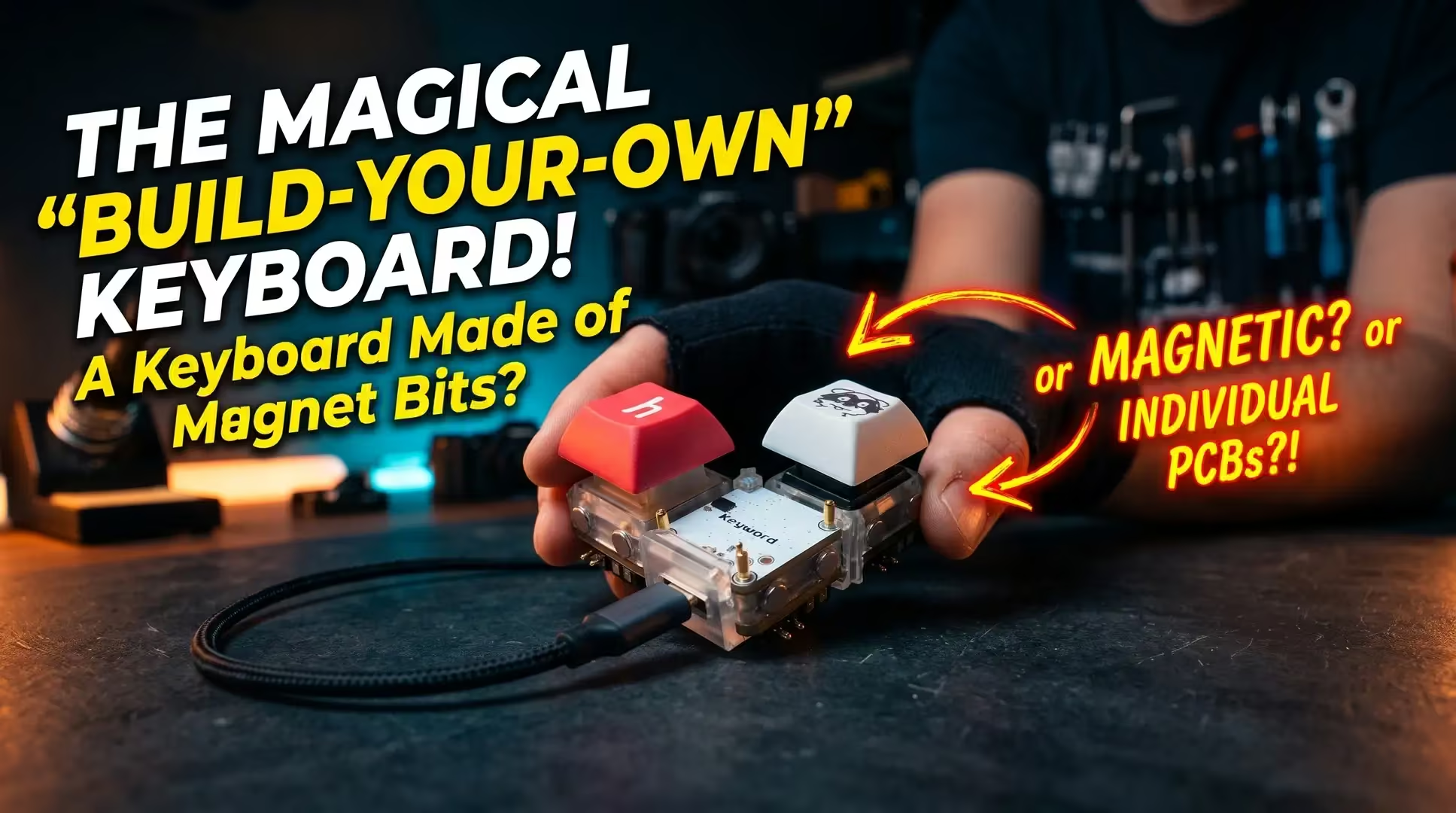
A modder known as notaroomba has released the latest revision of Keybytes, a modular mechanical keyboard project hosted on GitHub. Unlike traditional custom keyboards that rely on a single large PCB, Keybytes constructs the input device from individual units called “Keybits.” Each Keybit houses a full-height MX mechanical switch on its own dedicated circuit board.
The core innovation lies in the connectivity method. Every Keybit includes a RISC-V CH592F microcontroller and six magnets per side. These magnets allow the modules to snap together physically while maintaining data and power transmission. Crucially, the connection is rotation-agnostic, meaning users can arrange the keys in-line or at various offsets (25%, 50%, or 75%) without worrying about orientation errors during assembly.
Decoupling Layout from Hardware Constraints
For enthusiasts, the primary value of Keybytes is the removal of fixed form factors. Standard mechanical keyboards require pre-planned layouts; changing them usually means buying a new case, plate, and PCB. Keybytes decouples these elements. The system relies on a central component called the “Keyword,” which acts as the motherboard. This unit contains the USB Type-C port, battery charging circuitry, and a more powerful STM32WB55 MCU to manage the network of smaller Keybits.
This architecture supports experimental inputs beyond standard typing. Alternative PCB options include a version with a 3-axis Hall sensor, enabling joystick-like functionality or analog Hall effect switch behavior within the same modular grid. Spacer Keybits are also available in 1u, 0.75u, and 0.5u sizes, allowing for precise ergonomic adjustments or aesthetic spacing without modifying the electronic components.

Proof of Concept vs. Commercial Reality
Currently, Keybytes functions primarily as a proof of concept rather than a mass-market product. While the technical execution—particularly the automatic polarity detection and rotation-agnostic linking—is impressive, the complexity of manufacturing dozens of individual PCBs and MCUs suggests high costs and limited scalability for general consumers. However, it demonstrates a viable path toward truly customizable input devices, challenging the notion that keyboards must be static rectangular slabs.