The Split Identity of Next-Gen Mobile CPUs
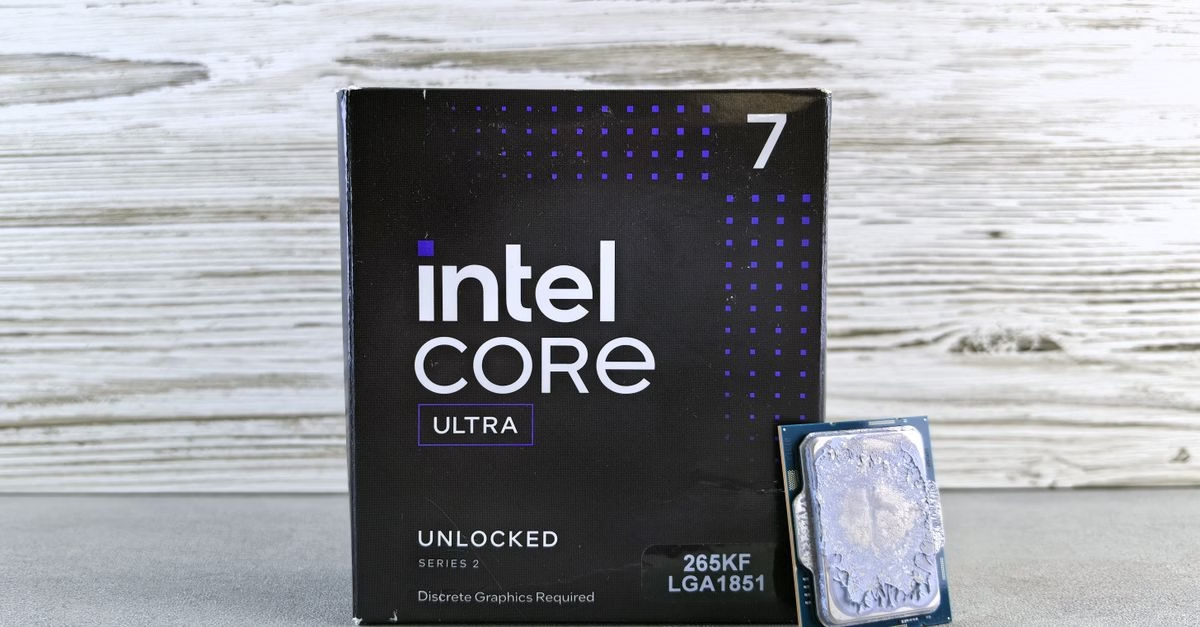
Prominent hardware leaker Jaykihn has reported that Intel’s upcoming Nova Lake-HX mobile processors will adopt the same four-digit naming convention seen in desktop chips. According to the report, these high-performance laptop CPUs will fall under the Core Ultra 4000 series, matching the format of the recently leaked Nova Lake-S desktop models like the Core Ultra 9 4970K BFC.
This development creates a distinct divide within Intel’s mobile lineup. While the top-tier HX chips move to the four-digit system, traditional H-series and suffix-less mobile processors will retain the three-digit naming structure of the previous generation. This suggests Intel is treating its most powerful laptop silicon as an extension of its desktop architecture rather than part of the broader consumer mobile family.
The leak also clarifies details from earlier August reports involving CPU-Z data. Previous mentions of Core Ultra 4000HX naming have now been reinforced by this newer information. Additionally, Jaykihn noted that non-BFC (big last-level cache) models likely retain their four LPE cores, a detail omitted from some initial leaked tables. Despite these specifics, no official model names for the HX variants have been released, and Intel remains silent on the matter.
Navigating Consumer Confusion in a Dual-Naming Era
For Canadian buyers and tech enthusiasts, this announcement highlights a growing complexity in Intel’s product segmentation. The coexistence of three-digit and four-digit naming schemes within a single generation forces consumers to decode two different classification systems simultaneously. It raises questions about how Intel intends to position its high-end laptops relative to its desktop counterparts.

The technical distinction appears rooted in architecture. Historically, HX chips have served as BGA versions of desktop silicon, sharing more DNA with the S-series than with standard mobile U or H parts. By grouping them under the Core Ultra 4000 banner, Intel may be signaling that these laptops offer desktop-class performance capabilities, just packaged in a portable form factor.
However, the lack of official confirmation leaves room for uncertainty. Without clear marketing from Intel, retailers and reviewers may struggle to communicate the value proposition of these devices. The reliance on leakers like Jaykihn and Golden Pig Upgrade underscores the opacity of Intel’s pre-launch communications. Consumers should expect a period of ambiguity before the products hit shelves, with qualification samples already appearing in tools like HWiNFO pointing toward an early 2027 release window.
Waiting for Official Confirmation
While the evidence strongly suggests a unified naming strategy for Intel’s high-end mobile and desktop chips, the company has yet to validate these claims. The reported shift to four-digit names for Nova Lake-HX processors represents a significant branding choice that could simplify or complicate the market depending on execution.
Until Intel provides official documentation, these details remain speculative. Buyers interested in next-generation high-performance laptops should monitor official announcements closely, especially as we approach the rumored early 2027 launch. For now, the industry must navigate a transitional phase where leakers fill the void left by corporate silence.