Extending Spectral Super Resolution to Standard Hardware
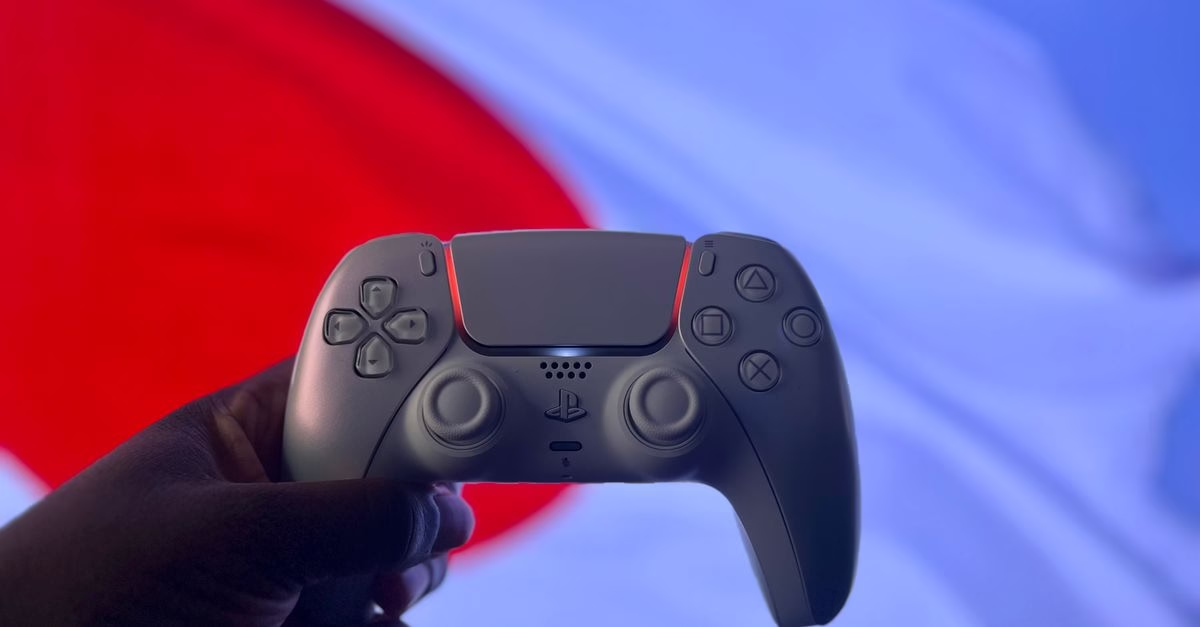
PlayStation has officially announced that it is bringing AI-based upscaling technology to the base PlayStation 5 console. In a recent blog post, the company detailed how this system builds directly upon the PlayStation Spectral Super Resolution (PSSR) technology currently employed on the PS5 Pro. According to Sony’s explanation, the new system works by analyzing game images pixel by pixel to upscale them, aiming to improve overall visual fidelity without requiring native resolution increases from the game engine itself.
This development marks a significant shift in how Sony approaches display output across its hardware lineup. Previously, PSSR was largely associated with the higher-end PS5 Pro, which utilizes dedicated AI accelerators to handle these complex calculations. By extending this capability to the base model, PlayStation is attempting to bridge the visual gap between its standard and premium consoles. The announcement suggests that Sony sees value in applying machine learning techniques to older or less powerful hardware to extend its relevance in a market where 4K displays are becoming the standard.
While the core mechanism—pixel-by-pixel analysis for upscaling—is confirmed, the exact method of delivery for the base PS5 remains somewhat abstract in the initial reporting. It is not yet clear if this will be a universal system-level update applied to all games, or if it will require specific developer integration similar to current PSSR implementations. The blog post serves as the primary source for this confirmation, outlining the technical philosophy behind the move rather than providing a step-by-step user guide for activation.
Visual Fidelity vs. Performance Trade-offs
For Canadian gamers and consumers worldwide, this announcement highlights a growing trend in console gaming: the reliance on software-based AI solutions to compensate for hardware limitations. The base PS5 has long been criticized for struggling to maintain stable 4K resolutions in demanding titles, often defaulting to dynamic scaling that can result in blurry or soft images. By introducing AI upscaling, PlayStation is offering a potential solution to these clarity issues, allowing the base console to output sharper images that better match modern high-resolution televisions.

However, this comes with inherent trade-offs. On the PS5 Pro, PSSR benefits from dedicated neural processing units that offload these tasks from the main CPU and GPU. The base PS5 lacks these specialized chips, meaning it must rely on its existing architecture to handle the computational load of AI upscaling. This raises questions about whether the process will introduce latency, reduce frame rates, or simply act as a lightweight filter that does not significantly alter performance. If the upscaling is handled inefficiently, it could negate the visual benefits by causing stuttering or input lag during gameplay.
Furthermore, this move signals Sony’s intent to keep the base PS5 competitive well into the next generation of displays. As more users upgrade to 8K TVs or high-refresh-rate monitors, the demand for crisp, clean images increases. By democratizing access to PSSR-like technology, Sony is ensuring that owners of the standard console do not feel left behind visually. Yet, without concrete benchmarks or official statements on performance impact, the actual benefit to the average player remains theoretical until widespread adoption and testing occur.
Rollout Questions Still Unanswered
The confirmation that PlayStation is bringing AI upscaling to the base PS5 is a promising step for visual quality, but it leaves several critical details unresolved. The most pressing unknown is how this feature will interact with existing game libraries. Will it be automatically enabled for all titles, or will developers need to opt-in? Additionally, the performance cost on non-Pro hardware is unclear; players should expect some uncertainty regarding potential frame rate drops or increased power consumption.
As with any new system-level feature, real-world performance will depend heavily on optimization and implementation. Until Sony provides more granular data on how PSSR functions on the base model’s specific silicon, the full scope of its benefits remains speculative. For now, the announcement stands as a commitment to improving image clarity across the board, but the practical experience for users will only become clear once the feature is fully deployed and tested in live environments.