What Happened on the Test Drive
The focus here is GM Super Cruise.
GM invited a small group of journalists to an early‑access run of its “Great Canadian Hands‑Free Drive” program, routing participants through a 300‑kilometre stretch of the Canadian Rockies. The test focused on Super Cruise’s ability to stay hands‑free on steep grades, tight curves, and variable weather typical of the region. Over the course of the drive, the system kept the vehicle centred in its lane for most of the journey, only prompting the driver to take over when the map data ran out or when an unexpected lane‑change was required.
The test vehicle—a 2025 Chevrolet Silverado equipped with the latest Super Cruise hardware—covered roughly 200 kilometres of highway without a single manual steering correction, according to the MobileSyrup report. However, the driver noted three distinct moments where the system warned of a lane‑change ahead, and the vehicle briefly drifted before the driver re‑engaged the steering wheel.
How Super Cruise Handles Mountain Roads
Super Cruise relies on a combination of high‑definition maps, lidar‑based lane‑keeping cameras, and a driver‑attention system that monitors eye‑movement. In the Rockies, the high‑definition maps cover the major highways, allowing the system to anticipate curves and adjust speed accordingly. The lane‑keeping cameras keep the vehicle centred, while the attention system ensures the driver’s eyes are on the road.

When the system detects a lane‑change ahead—usually signalled by a painted lane‑change arrow on the road—it alerts the driver with a visual cue on the instrument cluster and an audible chime. If the driver does not respond within a few seconds, Super Cruise disengages and returns control to the driver.
Because the test route included elevations above 2,000 metres, the system also had to manage engine braking and throttle modulation to maintain a comfortable speed on steep descents. The vehicle’s adaptive cruise control component handled this automatically, but the driver remained responsible for selecting the appropriate gear when the system’s torque limits were reached.
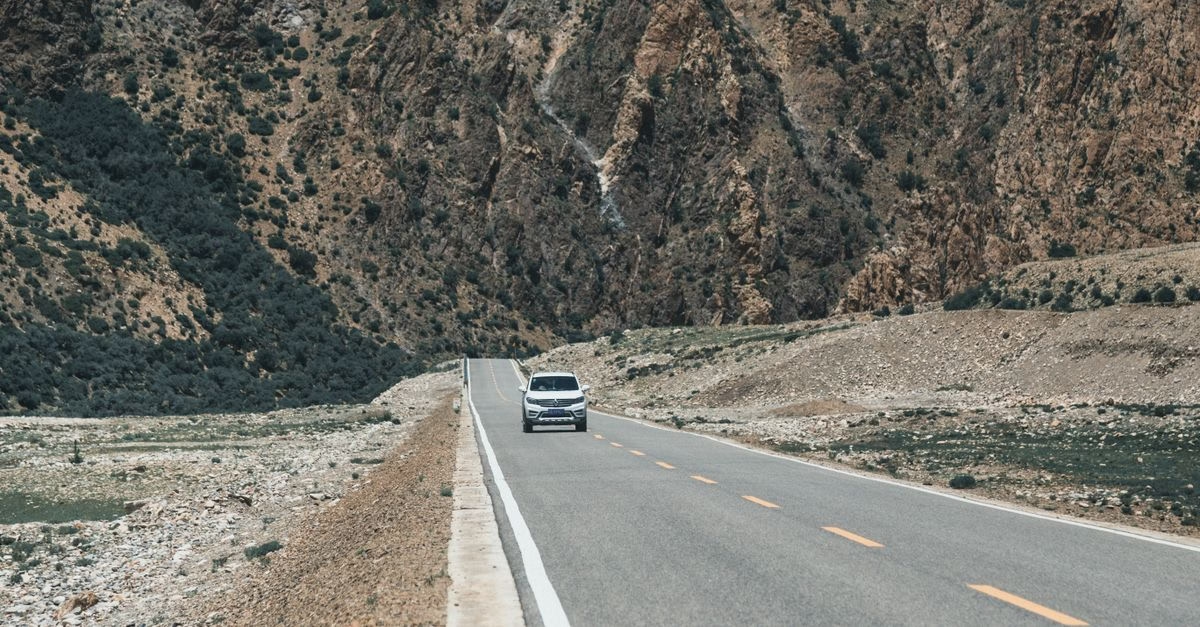
Photo by Zekai Zhu via Pexels.
Why This Test Matters to Canadian Drivers
Canada’s geography has long been a proving ground for driver‑assist tech. Long, isolated highway stretches make hands‑free cruising a genuine safety benefit—reducing fatigue on trips that can last several hours. Super Cruise’s success on a mountainous corridor suggests the technology is maturing beyond flat‑urban environments.
For owners of GM’s larger trucks and SUVs, the ability to let the car handle most of the steering on a mountain pass could translate into fewer accidents caused by driver fatigue. It also signals that GM is serious about expanding its hands‑free footprint across North America, potentially accelerating the rollout of Super Cruise‑compatible models in Canada.
However, the test also highlighted that the system is not yet a full‑self‑driving solution. The need for driver attention and the occasional disengagement mean that Super Cruise remains a Level 2 driver‑assist feature, not a Level 3 or higher autonomy system. Understanding these limits is crucial for anyone considering a hands‑free vehicle for long‑distance travel.
Practical Implications for Buyers
For Canadians eyeing a new GM vehicle, the Rocky Mountains test provides a realistic snapshot of everyday use. Here’s what to take away:
- Hands‑free cruising works on most highway segments. If your daily routes include long, straight stretches, Super Cruise can reduce steering fatigue.
- Map coverage matters. The system will disengage where high‑definition maps are missing—common in remote or newly built mountain passes.
- Driver attention is non‑negotiable. The eye‑tracking sensor will prompt you to keep your eyes on the road; ignoring it will shut the system off.
- Lane‑change alerts can be abrupt. Expect audible and visual cues; be ready to intervene quickly.
- Pricing and availability. Super Cruise is bundled with GM’s Premium Package on most 2025 models, adding roughly CAD 2,500 to the sticker price. It’s currently available on the Silverado, Sierra, and select Cadillac models in Canada.
Overall, the technology is a solid upgrade for those who spend a lot of time on highways, but it’s not a substitute for an attentive driver, especially in complex terrain.
Current Limitations and Open Questions
While the test was largely positive, several constraints emerged:
- Map gaps at high altitude. The system fell back to manual control on sections where the HD map data was incomplete, a common issue in remote mountain regions.
- Lane‑change handling. Super Cruise warned of lane changes but did not execute them automatically, requiring the driver to take over—an annoyance on busy highways.
- Weather sensitivity. Heavy snowfall or fog, which are frequent in the Rockies, can obscure lane markings, reducing camera reliability.
- Engine‑brake limits. On steep descents, the system may not provide enough engine braking, prompting the driver to downshift manually.
- Regulatory environment. Canadian provinces have varying rules on hands‑free operation; drivers must ensure they comply with local legislation.
Future updates are expected to expand map coverage and refine lane‑change logic, but for now, owners should treat Super Cruise as a convenience feature rather than a fully autonomous system.
Bottom Line
GM’s Super Cruise shows it can handle the demanding conditions of the Canadian Rockies, delivering genuine hands‑free cruising on long highway stretches. The technology reduces driver fatigue and showcases GM’s commitment to advanced driver assistance. Yet, map gaps, abrupt lane‑change prompts, and weather‑related camera issues mean the system still requires vigilant driver oversight. For Canadians who value long‑distance comfort but are comfortable staying in the loop, Super Cruise is a worthwhile upgrade—just don’t expect it to replace you entirely on mountain roads.