NATO‑Backed Startup Deploys AI‑Powered Drones to Ukraine
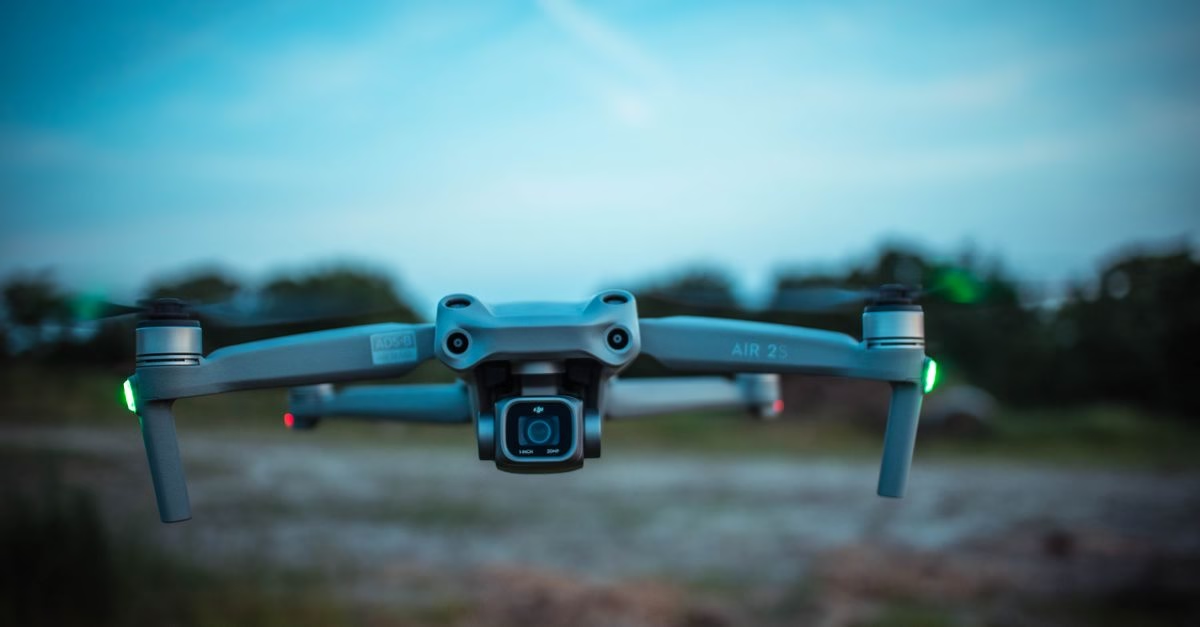
The focus here is autonomous drone AI. Scaleout, a startup backed by NATO research funds, announced a $100 million deal to deliver 50,000 low‑cost drones equipped with its proprietary AI models to Ukraine. The drones, originally designed for reconnaissance, now carry a compact neural network that can recognise vehicles, weapons caches and even individual combatants from live video feeds. Once a target is flagged, the system can either cue a human operator for confirmation or, in fully autonomous mode, release a payload directly at the identified point. The rollout is slated for late 2026, with field trials already underway on NATO training ranges.
The announcement follows a series of test flights where the AI correctly identified mock targets with a 92 % success rate, according to Scaleout’s internal data. The company stresses that the AI runs on edge hardware – a small processor mounted on the drone – meaning no constant satellite link or ground‑station computing is required.
How Tiny Neural Nets Enable On‑Board Target Recognition
Scaleout’s approach hinges on “small AI” – models trimmed to a few megabytes that can execute inference on low‑power CPUs. The training pipeline starts with massive labelled datasets of aerial imagery, which are then distilled into a lightweight version using techniques like pruning and quantisation. Once deployed, each drone continuously streams sensor data to a local inference engine. The model parses the video frame‑by‑frame, flagging objects that match its learned signatures.
A key innovation is decentralized learning. When a drone returns to base, it uploads its recent flight logs. Scaleout’s cloud service aggregates these logs, fine‑tunes the global model, and pushes updated weights back to the fleet. This feedback loop lets the swarm adapt to new terrain, camouflage patterns or emerging threats without a full‑scale re‑training effort.

The hardware stack consists of a ruggedised camera, an inertial navigation system and a custom AI accelerator chip roughly the size of a postage stamp. Power consumption stays under 5 watts, preserving the drone’s 30‑minute flight time. The entire AI package costs under $150 per unit, keeping the overall drone price near $300 – a fraction of traditional armed UAVs.
Why Autonomous Drone AI Changes the Battlefield for Canada and Allies
For NATO members, the technology offers a way to field large numbers of capable drones without the logistical burden of constant human pilots. Canada’s own defence procurement roadmap has highlighted “swarm‑ready” systems as a priority, and Scaleout’s solution fits that brief by delivering a cheap, scalable platform that can operate in contested electromagnetic environments where satellite links are jammed.
The ability to autonomously identify and strike targets also shifts the tactical calculus. Small drones can be launched en masse, saturating enemy air defences while each unit independently hunts for high‑value assets. This reduces the risk to manned aircraft and ground troops. Moreover, the decentralized learning model means the system can be customised for specific theatres – for example, training the AI on the unique vehicle silhouettes found in the Ukrainian plains.
However, the technology raises ethical and legal questions. International humanitarian law still requires meaningful human control over lethal decisions. Scaleout’s system includes a “human‑in‑the‑loop” mode where an operator must approve each strike, but the autonomous mode is also available for rapid‑response scenarios. Policymakers will need to decide where the line is drawn, especially as the hardware becomes affordable enough for non‑state actors.
What the Deployment Means for Canadian Defence Planning
If Canada opts to adopt Scaleout’s drones, the immediate benefit will be a rapid boost in ISR (intelligence, surveillance, reconnaissance) capability. Units could field a squad of ten drones for under $3,000, gaining real‑time video of enemy movements without risking pilots. The AI’s on‑board processing also means data can be analysed locally, cutting latency and bandwidth needs – a crucial factor in remote Arctic operations where satellite connectivity is sparse.
From a procurement standpoint, the low unit cost simplifies budgeting. The $100 million NATO contract translates to roughly $2 000 per drone when factoring in training, support and software updates – well within the Canadian Armed Forces’ medium‑term acquisition envelope. Integration with existing command‑and‑control (C2) systems will require API development, but Scaleout has released a RESTful interface that can feed target coordinates directly into NATO’s Joint Tactical Information Distribution System (JTIDS).
On the operational side, commanders will need new doctrines to manage autonomous swarms. Rules of engagement must specify when the AI can act without human confirmation, and training pipelines must teach operators to interpret AI‑generated alerts. The decentralized learning feature also implies a continuous data‑flow pipeline; secure, encrypted upload channels will be essential to protect sensitive battlefield footage.
Finally, the technology could spur a domestic supply chain. Canadian firms that specialise in ruggedised electronics, edge‑computing chips or AI model optimisation may find partnership opportunities with Scaleout, fostering a home‑grown ecosystem for autonomous weapons.
Where the System Still Falls Short
Despite its promise, Scaleout’s AI‑enabled drones have clear constraints. First, the model’s size limits its perception depth. While it excels at recognising large vehicles and static installations, it struggles with partially obscured targets or rapidly moving infantry, leading to a higher false‑negative rate in dense urban environments.
Second, the autonomous mode depends on reliable sensor data. Bad weather, dust storms or electronic interference can degrade camera feeds, causing the AI to misclassify terrain as a target. Scaleout mitigates this with sensor‑fusion algorithms, but the system still requires a clear line‑of‑sight for optimal performance.
Third, the $150 hardware price does not include the payload. Adding a warhead or loitering munition raises the per‑drone cost to roughly $400, which may still be cheap but could limit the number of units a unit can field in a single operation.
Lastly, the legal landscape remains unsettled. While Scaleout offers a human‑in‑the‑loop option, the autonomous mode could be deemed non‑compliant with emerging NATO guidelines on lethal autonomous weapons systems (LAWS). Until clear policy is established, many armed forces may restrict use to reconnaissance only, postponing the full attack capability.
These limitations mean the technology is best viewed as a force multiplier rather than a replacement for traditional air‑strike assets.
Bottom Line: A Game‑Changer with Caveats
Scaleout’s tiny AI models bring autonomous target identification to the cheapest tier of drones, offering NATO allies a scalable way to augment ISR and strike capabilities. For Canada, the system aligns with current defence priorities and could be fielded quickly and affordably. Yet the technology is not a silver bullet – sensor reliability, model accuracy and legal compliance all temper its immediate impact. As the swarm rolls out in Ukraine, real‑world data will clarify whether the promise of cheap, AI‑driven drones translates into a decisive tactical edge.
Until then, policymakers, procurement officers and field commanders should treat the system as a powerful supplement, invest in robust training and safeguards, and keep a close eye on the evolving regulatory framework around autonomous weapons.