What happened
Scaleout, a NATO‑backed startup, announced that its newly‑trained, ultra‑lightweight AI models can run on the limited compute hardware of small tactical drones. The models perform real‑time target detection, classification and, in some test scenarios, autonomous engagement. The company demonstrated the system in a series of field trials with partner forces, showing a reconnaissance drone locating a vehicle, relaying coordinates to a second drone, and then both drones striking the target without a human operator issuing a fire command.
The breakthrough hinges on compressing deep‑learning networks to a few megabytes, allowing them to execute on processors that weigh under 100 grams. Scaleout’s approach combines pruning, quantisation and a custom inference engine that leverages the drone’s existing camera pipeline. According to the company, the technology is now ready for integration into existing drone fleets used by NATO allies.

Photo by Matias Luge on Unsplash. Unsplash
How it works
Traditional autonomous drones rely on a ground‑station or cloud server to run heavy neural networks. Scaleout flips that model by embedding a stripped‑down convolutional network directly on the airframe. The AI ingests raw video frames, runs a detection head that flags objects of interest—vehicles, personnel, artillery pieces—and then passes the result to a decision module that evaluates engagement rules supplied by the operator.

Key technical steps include:
- Model compression: Starting from a standard ResNet‑50 backbone, Scaleout applied iterative pruning to remove redundant weights, followed by 8‑bit quantisation. The final model sits at roughly 3 MB and runs at 15 fps on a low‑power ARM Cortex‑A53.
- Edge inference engine: A bespoke runtime schedules GPU‑lite kernels to keep latency under 200 ms, crucial for fast‑moving targets.
- Rule‑based gating: Even though the AI can propose a strike, a hard‑coded rule set—such as “only engage if target confidence > 90 % and within 500 m of friendly forces”—must be satisfied before the weapon is released.
- Swarm coordination: In multi‑drone tests, one scout drone shares its target vector over a secure mesh network, allowing a second drone to converge and fire, effectively creating a lightweight swarm without a central commander.
All processing stays on‑board, meaning the drone can operate beyond line‑of‑sight or in contested radio environments where uplink bandwidth is limited.
Why it matters
Putting AI on the edge of the battlefield reduces latency, cuts reliance on satellite links and makes small drones viable strike platforms rather than just eyes in the sky. For NATO forces, that translates into faster target acquisition in fluid combat zones—think urban streets or rugged terrain where a human operator might be overwhelmed.
From a strategic perspective, the technology narrows the gap between high‑end, expensive UAVs and inexpensive hobby‑grade quadcopters. If a handful of cheap drones can autonomously locate and engage a target, the cost‑per‑kill metric drops dramatically, potentially reshaping procurement decisions.
However, the same capability raises profound ethical and legal questions. Autonomous lethal decision‑making, even when gated by pre‑set rules, challenges existing rules of engagement and the principle of meaningful human control. International bodies are already debating whether such systems should be classified as “lethal autonomous weapons” and subject to new treaties.
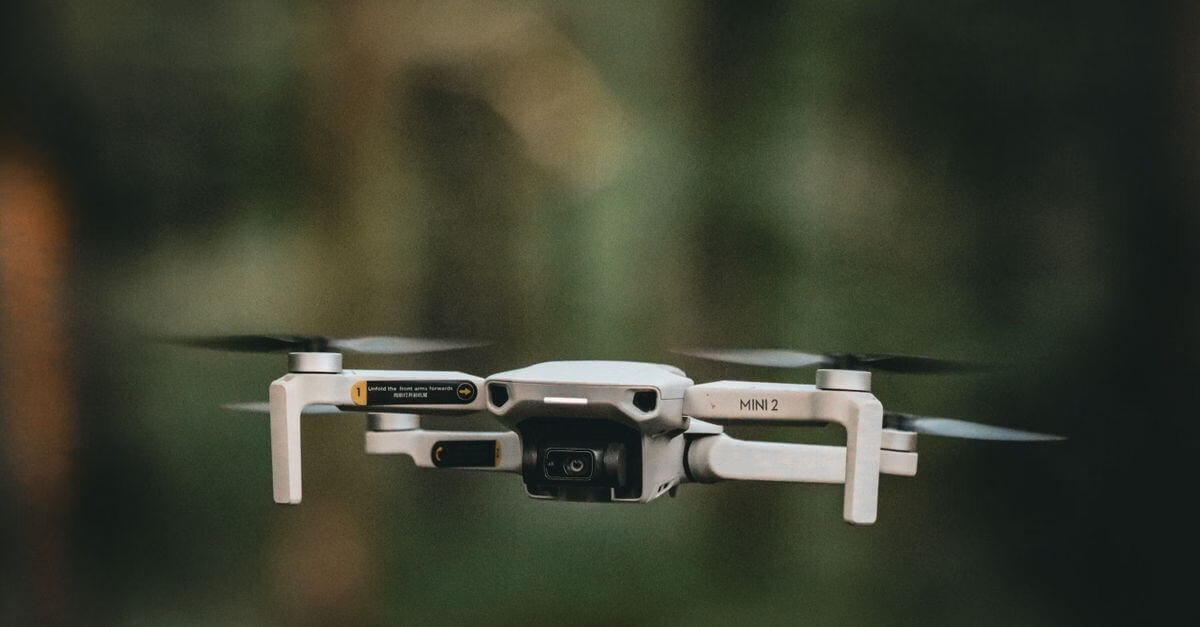
Photo by Nikola Tomašić via Pexels.
Practical implications for operators
For units that already field small UAVs, integrating Scaleout’s AI will likely involve a firmware update and a brief training cycle on the new engagement parameters. The system is designed to be plug‑and‑play with popular commercial drone frames, meaning existing inventories can be retrofitted rather than replaced.
Key operational benefits include:
- Reduced bandwidth usage: Since the AI processes video locally, only metadata and target coordinates need to be transmitted.
- Extended mission endurance: Eliminating constant video streaming conserves battery life, granting longer loiter times.
- Scalable swarm tactics: A single scout can coordinate multiple attack drones, enabling rapid saturation of a defended area.
Potential drawbacks are equally important. The compressed models, while efficient, are less robust to adversarial visual conditions—smoke, fog, or camouflage can degrade detection confidence. Operators must therefore maintain a fallback manual control channel and be prepared to abort autonomous engagement if confidence thresholds dip.
Logistically, the need for secure, tamper‑proof firmware signing adds a layer of supply‑chain complexity. Nations without established cyber‑security pipelines may struggle to certify the software for field use.
Limitations and open questions
Despite the hype, the technology is not a silver bullet. The AI’s accuracy, reported at roughly 92 % for vehicle detection in open terrain, drops to the low‑80s in cluttered urban settings. False positives could lead to unintended collateral damage, a risk that current NATO doctrine does not fully address.
Another limitation is the lack of on‑board situational awareness beyond visual cues. The models cannot currently fuse radar or LIDAR data, which limits performance in low‑light or obscured environments.
Open questions remain about command‑and‑control protocols. How will rules of engagement be updated in real time? What safeguards prevent a compromised drone from being hijacked and used against friendly forces? Scaleout’s public statements acknowledge ongoing work on secure OTA (over‑the‑air) updates, but timelines are vague.
Finally, the legal landscape is unsettled. While NATO members have expressed interest, no formal treaty or export‑control regime specifically covers AI‑enabled lethal drones. Until governments codify standards, procurement decisions will be made on a case‑by‑case basis, potentially creating a fragmented market.
Bottom line
Scaleout’s on‑board AI pushes the envelope of what tiny drones can do, turning them from passive sensors into autonomous strike assets. The technology promises faster, more resilient operations for NATO forces, but it also surfaces serious ethical, legal and technical challenges that must be addressed before widespread deployment. As the line between reconnaissance and lethal action blurs, policymakers, engineers and commanders will need to work together to ensure the technology is used responsibly and effectively.