Independent Tests Expose Performance of OEM Graphics Card
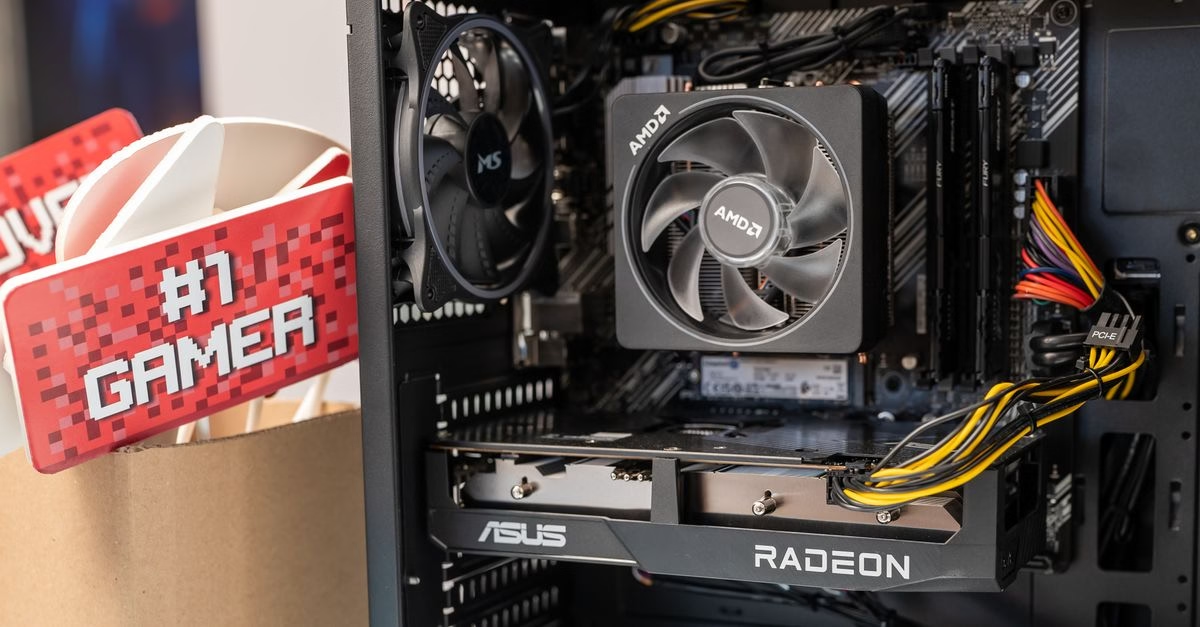
Independent hardware channels Hardware Unboxed and Toasty Bros recently managed to acquire and test the elusive Radeon RX 9050 4 GB. Because AMD restricts distribution of this specific hardware configuration exclusively to prebuilt OEM desktop manufacturers, both channels had to purchase CyberPowerPC prebuilt systems from retailers like Best Buy to get their hands on a unit. The system inspected by Toasty Bros featured an XFX dual-fan card equipped with a single 8-pin power connector, indicating that multiple board partners are assembling the hardware. The card was initially spotted inside a prebuilt Gamer Master desktop priced at $889.99 CAD. These disclosures provide the first clear look at hardware that AMD built quietly for entry-level market segments without sending review samples directly to independent media outlets.
The Architectural Bottleneck Behind the Hardware
Under the hood, both the 4 GB version and its faster 8 GB counterpart share 1,024 Stream Processors alongside boost clocks reaching up to 2.6 GHz. The stark performance divergence stems entirely from memory subsystem cuts confirmed directly by AMD. While the standard 8 GB model maintains a balanced configuration, the Radeon RX 9050 4 GB is restricted to a narrow 64-bit memory bus. This design limits memory bandwidth to 144 GB/s and shrinks the onboard Infinity Cache down to just 16 megabytes, which is exactly half of the cache and bus width found on the 8 GB sibling. When running modern titles at 1080p resolution, this halved memory interface creates an immediate bottleneck that severely impacts frame delivery and consistency during active gaming sessions.
Why Memory Restrictions Matter for Budget PC Buyers
In Hardware Unboxed’s rigorous 18-game test suite run at 1080p Low settings, the 4 GB card managed an average of 78 frames per second with 55 FPS 1% lows. By comparison, the 8 GB variant averaged 107 frames per second with 78 FPS 1% lows, making the higher-capacity model roughly 37 percent faster overall. Even when tested at absolute minimum graphics presets, the 8 GB model maintained a commanding lead, delivering 147 FPS against the 4 GB card’s 111 FPS. Launching a discrete graphics card equipped with a meager 4 VRAM gigabytes in the current hardware climate raises serious eyebrows among enthusiasts. For Canadian consumers purchasing prebuilt entry-level machines, encountering such a severe performance penalty hidden behind a modern naming convention highlights the risks of buying opaque OEM configurations.
What Prebuilt Buyers Need to Watch For
Consumers shopping for entry-level prebuilt desktop systems must carefully examine component spec sheets rather than relying solely on family branding. Because AMD has explicitly stated it has no plans to sell the 4 GB variant as a standalone retail part, casual shoppers will only encounter this hardware pre-installed inside partner systems. Finding a system priced near $900 CAD that houses a severely memory-constrained GPU means buyers could unknowingly purchase a machine with heavily restricted graphical longevity. Reviewers noted that an increase from 60 to 80 frames per second on stronger hardware is predictable, but dropping down to the performance tier of the 4 GB model severely limits smooth gameplay in modern titles that demand larger frame buffers right out of the box.

Current Data Limits and Unanswered Questions
While these initial benchmarks provide a clear snapshot of hardware behavior, concrete conclusions remain limited by sample size. Only two independent tech outlets have published comprehensive test results on this specific OEM configuration so far. Furthermore, potential variations in system memory, motherboard pairings, and power delivery across different prebuilt brands could yield slight performance deviations. Independent reviewers also noted initial friction surrounding hardware availability and corporate communication, pointing to a tight grip on review units. Additional testing across a broader selection of titles and system configurations will be required to see if driver updates or alternative tuning can extract any extra breathing room from the constrained bus.
A Disappointing Reality for Entry-Level System Builders
The emergence of the Radeon RX 9050 4 GB benchmarks underscores the pitfalls of heavily stripped-down memory configurations in modern gaming hardware. Cutting the memory bus, bandwidth, and cache in half results in a compounding performance deficit that leaves the 4 GB card trailing its 8 GB sibling by over a third. While designed specifically to hit aggressive price points for system integrators, shipping a 4 GB card in current market conditions feels remarkably out of touch. Canadian gamers and budget-conscious buyers should look closely at system specifications to ensure they secure balanced hardware rather than paying for a severe performance bottleneck hidden inside an OEM enclosure.
The focus here is Radeon RX 9050 4 GB. When examining the broader landscape of budget desktop solutions, the inclusion of heavily compromised hardware components often undermines the initial value proposition of an entry-level purchase. System integrators rely on familiar series names to attract consumers who may not closely inspect individual memory specifications, bus widths, or cache sizes. Because the Radeon RX 9050 name is shared between the 4 GB and 8 GB variants, buyers can easily assume they are getting comparable silicon efficiency. However, the hard limitations imposed by the 64-bit bus and 16 MB of Infinity Cache create an irreversible bottleneck that cannot be bypassed through software optimizations alone. As modern game engines continuously demand larger frame buffers and faster data streaming from system memory, hardware configurations with restricted bandwidth will struggle to maintain stable frame pacing, leading to stutter and dropped inputs during intensive gameplay sequences.
The decision by hardware manufacturers to restrict certain SKUs exclusively to prebuilt OEM channels often complicates consumer research. Without independent reviews from channels like Hardware Unboxed and Toasty Bros, everyday buyers would have no immediate way of knowing that the prebuilt machine sitting on a retail shelf carries a 37 percent performance penalty compared to a properly configured sibling. This lack of market transparency places a heavy burden on consumers to verify exact component model numbers before committing funds. For anyone shopping on a strict budget, putting down hundreds of dollars on a system that utilizes a severely constrained graphics processor means sacrificing the longevity and upgrade potential that a balanced system should naturally provide.
Ultimately, prospective buyers should treat these findings as a cautionary reminder to look past headline pricing and promotional summaries. Checking detailed component specifications, independent performance benchmarks, and user reviews remains essential when evaluating prebuilt desktop computers. While entry-level systems will always involve compromises to hit accessible price points, sacrificing fundamental memory bandwidth and capacity to such a degree results in a compromised user experience. Until more comprehensive data emerges from additional independent testing, consumers are best advised to prioritize configurations featuring the 8 GB model or alternative hardware that avoids these steep memory penalties, ensuring their gaming investments remain viable for years to come.