Meta introduces text-to-game AI suite
Meta has officially detailed two new generative AI tools aimed at simplifying game development: Horizon Create and Horizon Studio. These platforms allow users to construct playable 2D and 3D games by describing their ideas in natural language. The announcement marks a significant shift toward accessible, AI-assisted content creation within Meta’s ecosystem.
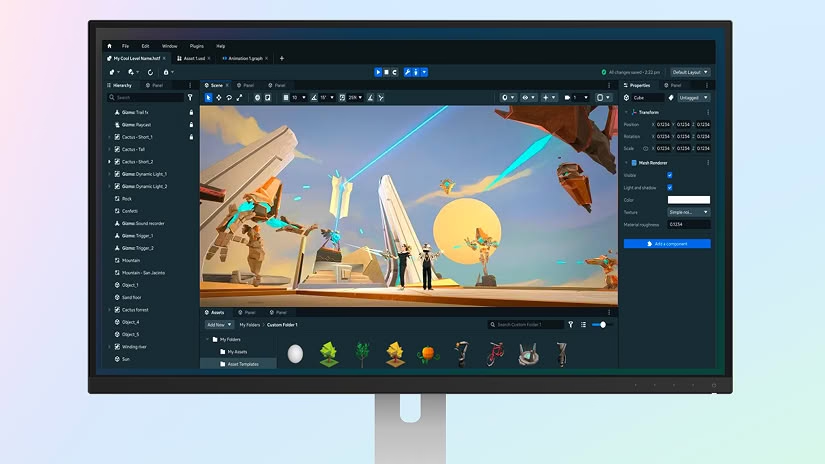
Horizon Create is designed as a mobile application, targeting users who want to build games quickly while on the go. In contrast, Horizon Studio operates as a web-based tool, providing more granular controls for creators who wish to edit specific details such as art direction, difficulty settings, and progression systems. Both tools are built on the Meta Horizon Engine, ensuring they can leverage the company’s existing infrastructure for rendering and physics.
Saxs Persson, Vice President of Horizon, emphasized that these tools produce finished, playable experiences rather than rough sketches or prototypes. He stated that users can open the app, describe the game they want in their own words, and have the system begin building it immediately. This approach lowers the barrier to entry for game design, allowing individuals without traditional coding or modeling skills to create interactive content.
Lowering barriers for social game creation
The introduction of these tools matters because it integrates game creation directly into Meta’s social platforms. Creators can publish their generated games across Facebook and Instagram, potentially turning passive scrolling into interactive engagement. This could lead to a surge in user-generated content that is more dynamic than static images or videos.

The iterative nature of the AI allows for rapid prototyping and refinement. Users can reimagine environments, change characters, or add new quests with a single prompt. This flexibility means that gameplay can be tweaked to accommodate different skill levels, making games more accessible to a broader audience. For casual creators, this removes the technical friction often associated with game engines like Unity or Unreal.
However, the reliance on AI generation raises questions about originality and quality control. While the tools promise depth, the actual complexity of the resulting games remains to be seen in widespread public use. The move also positions Meta to compete more directly with other platforms fostering user-generated content, leveraging its massive user base to populate its metaverse ambitions with ready-made experiences.
A new era of prompt-based gaming
Meta’s launch of Horizon Create and Horizon Studio represents a clear push to democratize game development through artificial intelligence. By enabling text-to-game creation, Meta is betting that ease of use will drive volume and engagement on its social networks. The distinction between the mobile-focused Create and the web-based Studio offers a tiered approach to creativity, catering to both casual users and more dedicated designers.
While the technology promises to deliver playable games with real depth, its long-term success will depend on the quality of the AI outputs and the community’s willingness to adopt these new creation workflows. As these tools roll out, they will likely reshape how users interact with social media, blending consumption with creation in unprecedented ways.