The latest Apple hardware rollout
Apple has officially launched its newest hardware suite, headlined by the iPhone 18 Pro and iPhone 18 Pro Max. This release also includes the Apple Watch Series 12 and the rugged Apple Watch Ultra 4. These devices were showcased at a recent event in Cupertino, where early access allowed for initial testing and hands-on evaluation of the build quality and feature sets. This launch follows the recent introduction of the AirPods 5, completing a comprehensive update to Apple’s primary consumer electronics categories. The event served as a definitive marker for the company’s trajectory, emphasizing a shift toward more integrated, high-performance computing that bridges the gap between professional-grade tools and consumer-friendly interfaces. By consolidating these releases, Apple is clearly attempting to synchronize its ecosystem, ensuring that the latest iOS and watchOS iterations are fully optimized for the specific silicon and sensor arrays housed within these new chassis designs.
Evaluating the new device ecosystem
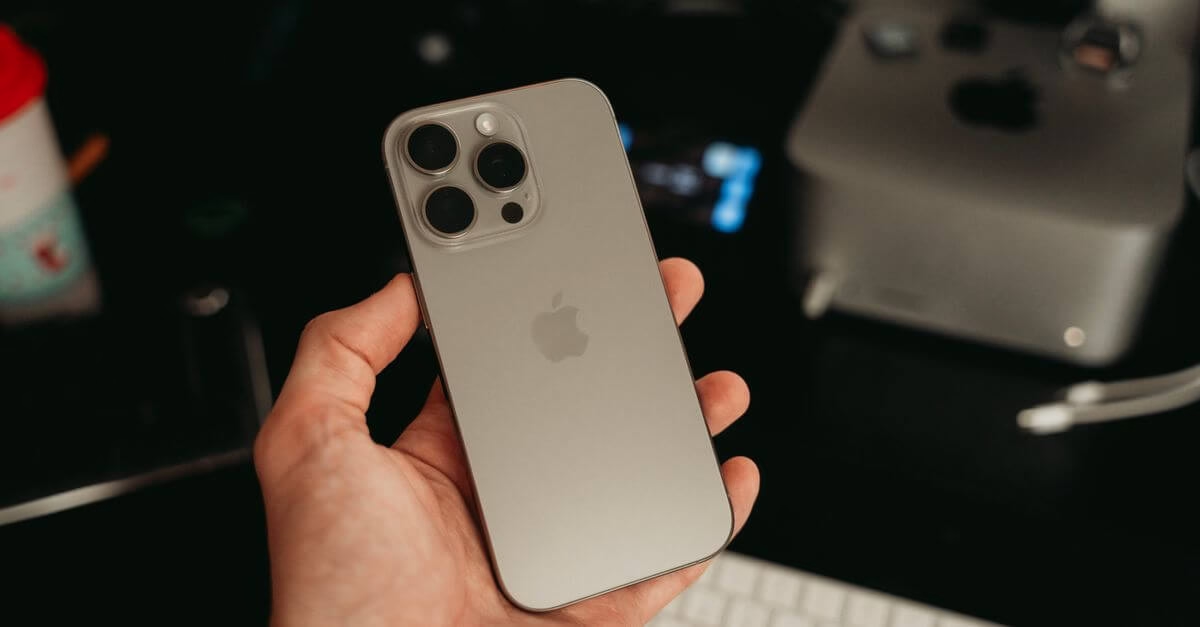
The iPhone 18 Pro series continues to build upon the established architecture of previous Pro models, focusing on iterative improvements to processing power and hardware integration. For the wearables, the Apple Watch Series 12 and Ultra 4 utilize updated sensor arrays and refined software interfaces to track health and activity metrics. The hands-on process involves assessing how these internal upgrades translate to daily usability, specifically looking at how the new Pro-tier features interact with the latest watchOS and iOS iterations. We are seeing a concerted effort to push the boundaries of what a mobile device can handle in terms of computational photography and real-time data processing. The integration between the watch and the phone is tighter than ever, suggesting that Apple is betting heavily on the ‘connected companion’ model, where the watch acts not just as a notification hub, but as a critical biometric sensor that feeds directly into the iPhone’s health and productivity dashboards.
A sharp take on the upgrade cycle
For the average user, the iPhone 18 Pro represents the current ceiling of Apple’s mobile capabilities. The significance of this launch lies in whether the hardware improvements justify the transition from previous generations. While the Apple Watch Ultra 4 continues to target the high-performance segment, the Series 12 remains the benchmark for the standard wearable experience. Understanding these devices matters because they dictate the standard for mobile connectivity, photography, and personal health tracking for the next twelve months. The upgrade cycle has become increasingly nuanced; it is no longer about raw speed, as most users have reached a plateau where current devices are more than capable of handling daily tasks. Instead, the value proposition has shifted toward specialized utility—better low-light camera performance, more granular health monitoring, and improved power efficiency. For the consumer, the question is whether these incremental gains provide enough utility to offset the cost of a full device replacement.
What to expect from the new lineup
Prospective buyers should note that the iPhone 18 Pro series is designed for users who prioritize camera performance and sustained processing power. The Apple Watch Series 12 offers a balanced approach for daily use, while the Ultra 4 is specifically engineered for durability and specialized outdoor activities. Before committing to an upgrade, it is practical to consider whether your current device is reaching its performance limit or if these new features offer a tangible benefit to your specific workflow or lifestyle. If you are a power user who relies on high-bitrate video recording or complex multitasking, the iPhone 18 Pro’s thermal management and processing overhead will be immediately noticeable. Conversely, for the average user, the benefits may be more subtle, manifesting in better battery life or a slightly more responsive interface. It is essential to weigh these hardware capabilities against your actual usage patterns rather than simply chasing the latest model number.

Unanswered questions and trade-offs
While initial hands-on time provides a glimpse into the hardware, long-term battery life, thermal management under heavy load, and the durability of new materials remain to be fully vetted. Furthermore, the specific software optimizations that may be exclusive to the iPhone 18 Pro versus the standard models are still being explored. As with any new release, early adopters should be aware that initial software versions may require subsequent updates to reach peak stability. We also need to see how the new sensor arrays in the Apple Watch Ultra 4 hold up in extreme environments over extended periods. There is always a risk with first-generation material implementations or new sensor configurations. While the initial impressions are positive, the real-world performance—specifically regarding battery degradation and software bugs that only appear after weeks of usage—is something that can only be determined through rigorous, long-term testing rather than a brief, controlled event.
Final thoughts on the new hardware
The arrival of the iPhone 18 Pro and the latest Apple Watch models marks a significant point in the annual hardware cycle. By focusing on refined performance and specialized utility, Apple continues to iterate on its core product lines. Whether these devices represent a necessary upgrade depends largely on the user’s current hardware and specific needs. As more detailed testing emerges, the true value proposition of this generation will become clearer. It is clear that Apple is not looking to reinvent the wheel, but rather to polish the existing experience to a mirror finish. For those currently using a device that is two or three years old, the jump in performance and efficiency will be substantial. However, for those who upgraded just last year, the decision to switch will likely come down to specific, niche feature requirements rather than a broad, across-the-board necessity. The ecosystem remains robust, and these devices are the current pinnacle of that vision.