ASRock Expands DeskSlim Line with Blackwell GPU Support
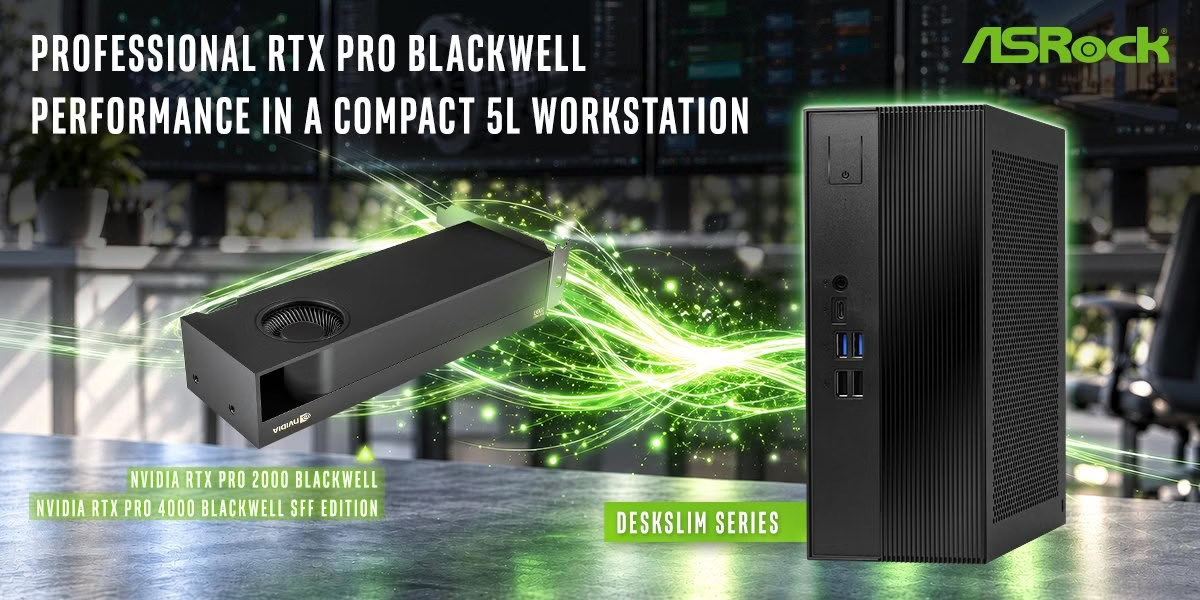
ASRock has officially announced that its DeskSlim X600 and DeskSlim B760 compact desktop platforms are now compatible with NVIDIA’s latest professional graphics solutions. Specifically, the manufacturer confirms support for the NVIDIA RTX PRO 4000 Blackwell SFF Edition and the NVIDIA RTX PRO 2000 Blackwell professional graphics cards. This development marks a significant step in bridging the gap between high-end workstation performance and space-constrained environments.
The core of this compatibility lies in the hardware design of the DeskSlim series. These systems are built around a compact 5-liter chassis, which traditionally limits the size and power of installed components. However, ASRock has engineered these units to include a PCIe 5.0 x16 expansion slot. This slot is specifically designed to accommodate low-profile, dual-slot graphics cards that measure up to 200 mm in length. This specification allows users to install powerful, yet physically smaller, professional-grade GPUs without sacrificing the system’s footprint.
The announcement highlights the DeskSlim X600 and B760 as versatile platforms. While they maintain the small physical dimensions typical of mini PCs or ultra-compact desktops, they offer the expandability usually reserved for larger tower workstations. This approach targets users who need substantial graphical processing power but lack the desk space or physical environment for traditional large-case systems. The integration of Blackwell architecture into such a small form factor represents a notable engineering achievement, allowing for dense computing power in areas where airflow and thermal management are typically challenging constraints.
Why Compact Professional Workstations Are Gaining Traction
For professionals in fields like AI-assisted workflows, content creation, 3D visualization, engineering applications, and data analysis, the ability to run demanding software on a small desk is increasingly valuable. The introduction of RTX PRO Blackwell cards into a 5L chassis addresses a critical pain point: the trade-off between performance and space. Historically, achieving desktop-class expandability required a large tower case, which is not feasible in shared offices, home studios, or mobile setups.

The significance of this move extends beyond mere convenience. By supporting PCIe 5.0, ASRock ensures that the DeskSlim series remains future-proof. PCIe 5.0 offers higher bandwidth than previous generations, which is essential for transferring large datasets quickly—a common requirement in data analysis and 3D rendering tasks. Furthermore, the inclusion of low-profile, dual-slot cards means that these systems can fit into standard rack mounts or tight under-desk configurations, opening up new possibilities for industrial and commercial deployments.
However, it is important to note that while the hardware supports these GPUs, the actual performance will depend on thermal conditions within the 5L chassis. Small form factor systems often face thermal throttling when pushing high-wattage components. Therefore, while the specifications promise high performance, real-world sustained workloads may vary based on cooling efficiency. This makes the DeskSlim series particularly relevant for users who prioritize portability and space-saving over absolute maximum continuous throughput. It also signals a broader industry trend toward consolidating workstation capabilities into smaller, more energy-efficient packages, which aligns with sustainability goals in modern office environments.
The Future of Space-Efficient Professional Computing
ASRock’s announcement underscores a growing demand for powerful yet unobtrusive computing solutions. The DeskSlim X600 and B760 platforms demonstrate that manufacturers are successfully adapting to the needs of professionals who require robust graphical capabilities without the bulk of traditional workstations. By integrating support for NVIDIA’s RTX PRO Blackwell SFF Edition cards, ASRock provides a viable option for those working in constrained spaces.
While the technical specifications are impressive, potential buyers should consider their specific workload requirements. For tasks that involve intermittent bursts of high-intensity computation, such as rendering or model training, the compact form factor may be ideal. However, for continuous, heavy-duty processing, the thermal limitations inherent in a 5L chassis could impact long-term stability. As the technology matures, we can expect further refinements in cooling solutions and component density, making these compact workstations even more competitive with their larger counterparts. For now, the DeskSlim series stands out as a practical choice for professionals seeking a balance between power, portability, and precision.